
Liquidity and the Reward for Patience
INSIGHTS · INVESTMENT PRINCIPLES · SEPTEMBER 2026
Understanding liquidity, the illiquidity premium and how thoughtful investors put time to work
DATE: 24th September 2026 READING TIME: 8 mins
Two investments can offer the same expected return and still hold distinct values for an investor. The difference often lies in how easily each can be turned back into cash. To familiarize yourself with the difference, and knowing which part of a portfolio can afford to wait, is one of the most rewarding disciplines in wealth management.
Every investment decision involves an exchange. Investors commit capital today in return for the prospect of greater value tomorrow, and in doing so they accept certain conditions, some visible and some less so. Risk is the condition most often discussed. Access, meaning the freedom to change course and return to cash, receives far less attention, even though it shapes both the returns an investment can offer and its place within a portfolio.
For families building wealth across generations, access is also a resource that can be put to work. Capital that will not be needed for many years has a quiet advantage, because it can earn returns that shorter-term capital cannot. Using that advantage well begins with understanding what liquidity is and how markets reward those who can offer patience.
“Patience is an asset in its own right, and markets are willing to pay for it.”
I. What liquidity really means
Liquidity describes how readily an asset can be converted into cash without materially affecting its price. Both parts of that definition matter. Almost any asset can be sold quickly if the seller accepts a sufficiently low price, so true liquidity means selling promptly and at a fair value.
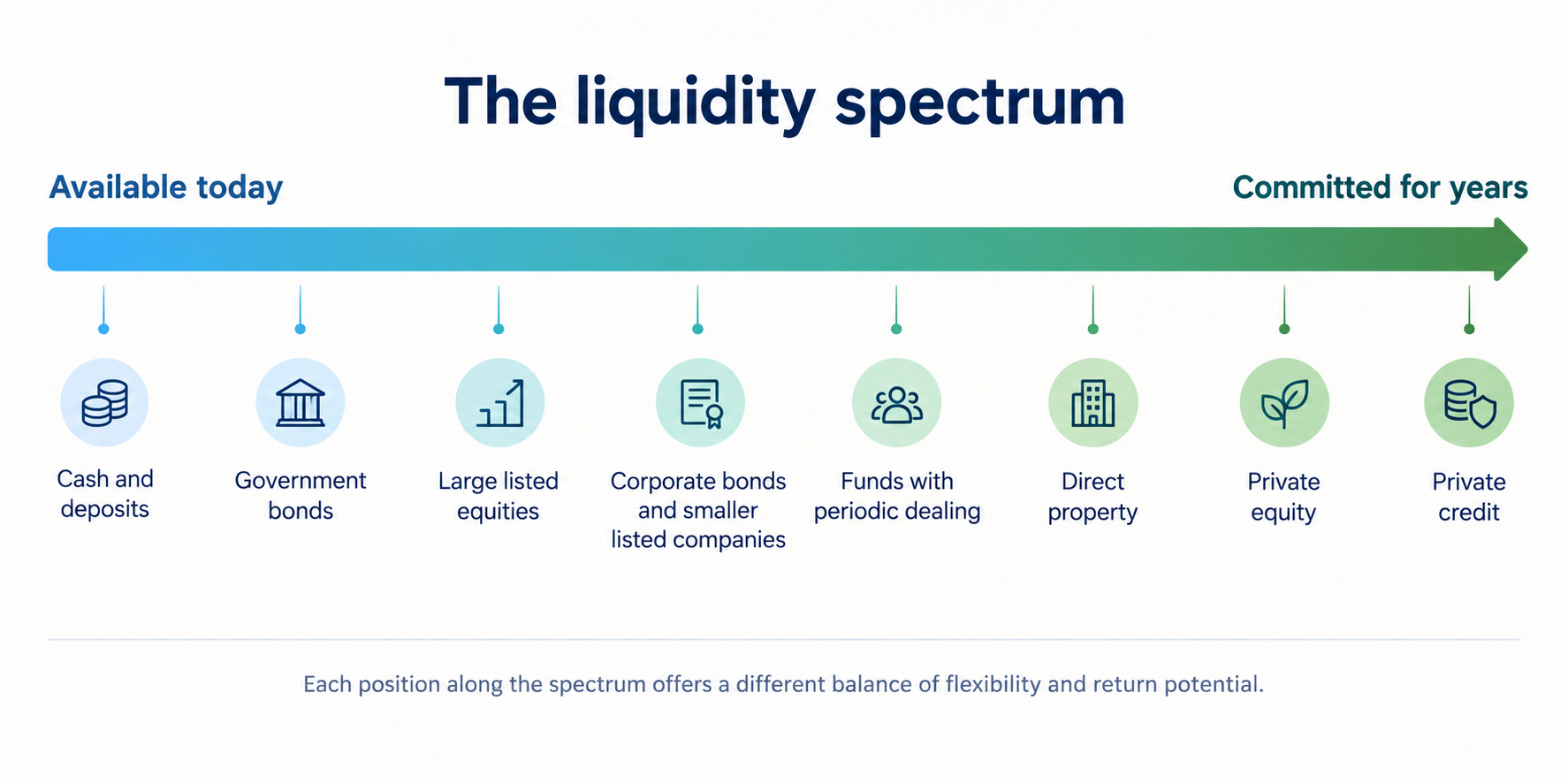
Assets sit along a broad spectrum. Cash lies at one end, followed closely by government bonds and large listed companies, which trade continuously in deep markets. Further along are smaller listed companies, corporate bonds and funds with periodic dealing. At the far end sit private company holdings, direct property and specialist funds, which can hold considerable value while taking months or even years to sell.
II. Why access carries a price
Imagine two investments with identical prospects. One can be sold this afternoon at a fair price. The other requires a sale process lasting a year, with some uncertainty about the final price. Most investors would naturally prefer the first on equal terms, so the second must offer something more to attract capital. That additional expected return is known as the illiquidity premium.
The illiquidity premium compensates investors for accepting a restriction on access. The underlying business may be every bit as sound as its listed equivalent. What the investor provides is a commitment of time, and the premium is the market's recognition of that commitment.
III. Understanding the source of every return
A valuable discipline follows from this. When an expected return looks especially attractive compared with similar alternatives, the most useful response is a thoughtful question about where that return comes from. Every return has a source, and identifying it is the heart of sound investment analysis.
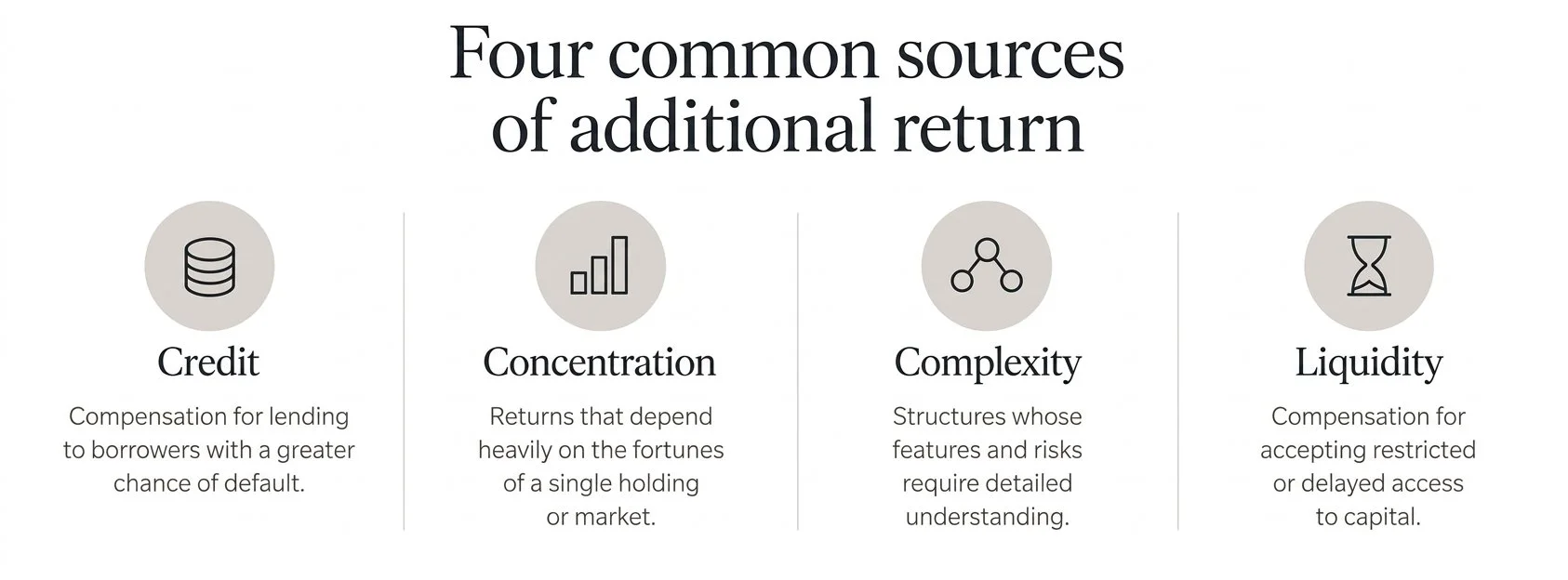
The source may be credit risk, where the investor is compensated for lending to a less established borrower. It may be concentration, where a large share of capital depends on a single company, sector or region. It may be complexity, where the structure of an arrangement requires careful study to understand fully. Very often it is liquidity, and liquidity deserves particular attention because its value tends to become most apparent at the moment it is needed.
IV. Matching access to purpose
Thoughtful portfolio construction therefore begins with time horizon, and return targets follow. Capital that may be needed soon belongs in accessible form, whatever fewer liquid alternatives may offer. Capital that will genuinely not be required for a decade or more can embrace commitments that would be unsuitable elsewhere, and it is precisely this capital that is best placed to earn the rewards of patience.
V. A perspective from the Gulf
For many families in the region, this discussion has particular relevance. Wealth here has often been built through family enterprises and property, both of which are valuable, long-term and naturally less liquid. These holdings already provide substantial exposure to the rewards of patience.
How We Approach This at Marigold
We design portfolios around each client's complete picture, including business interests, property and future commitments. Our strategies span liquid, actively managed approaches and longer-horizon opportunities, so that every portion of capital is matched thoughtfully to its purpose. For families and structures such as foundations and trusts, we also offer discretionary management under Investment Management Agreements.
This article is general information and does not constitute investment advice, an offer, or a recommendation to invest. Marigold Capital Advisors Limited is regulated by the Dubai Financial Services Authority, and its services are available to Professional Clients only. Past performance is not a reliable indicator of future results, and different types of investment carry varying degrees of risk.